



Kurz gesagt: yes, you can do Kakadu in a day from Darwin, but it is a long one. Parks Australia says the drive takes about three hours each way, so a day tour is roughly 12 hours and gives you the highlights (Ubirr rock art, wetlands, Cahills Crossing) rather than the waterfalls. Most people who want swimming holes and Yellow Water pick a 3 to 5 day trip. You do not need a 4WD for the main sights, and you should not swim in Kakadu’s natural waterways unless a ranger-managed sign says you can.
Facts below were checked on 27 October 2026 against Parks Australia’s Kakadu site (kakadu.gov.au), the UNESCO World Heritage listing and the Northern Territory Government. Passes, closures and swimming access change, so check the park’s live access report before you go.
Questions: getting there and how long
Can you do Kakadu in a day from Darwin?
Yes. Day tours leave Darwin in the morning and are back in the evening, about 12 hours in total. The operators on our day tours put the full loop at about 620 km with around 2 km of walking, so expect a lot of time on the road and a handful of stops. A day gets you Ubirr rock art, the Bowali Visitor Centre and Cahills Crossing, plus a wetland or river cruise depending on the tour.
Is a Kakadu day trip from Darwin worth it?
Yes, if you only have one day or you want the rock art and the crocodiles without committing to camping. It is not worth it if your main goal is swimming at waterfalls, because the plunge pools such as Maguk, Gunlom and Jim Jim are further into the park and are covered by multi-day trips. The Kakadu Rock Art and Wetlands Day Tour gibt’s ab 159 € and includes the park pass.
How far is Kakadu from Darwin?
About three hours by road. Parks Australia describes the journey from Darwin via the Stuart Highway and Arnhem Highway as taking about three hours. The Northern Territory is large, and Kakadu itself is big enough that driving between sights inside the park adds more time on top.
How many days do you need in Kakadu?
Two to three days covers the main sights and a waterfall or two. Parks Australia’s own sample itineraries run from 3 to 7 days. One day works as a taster. If you add Katherine Gorge (Nitmiluk) and Litchfield, plan four or five days, which is what the longer tours below do.
Can you visit Kakadu without a tour?
Yes. You can hire a car in Darwin and drive in yourself, and Parks Australia lists 2WD, 4WD and motorhome hire in Darwin as options. The catch is distance and timing: it is a three-hour drive each way, there is a lot of dirt-road driving once you leave the main routes, and you have to organise your own cruises and park pass. A tour solves the driving and the logistics, and it makes more sense for solo travellers splitting costs with a group.
Do you need a 4WD to visit Kakadu?
Not for the headline sights. Parks Australia says some parts of Kakadu can only be reached by 4WD, but many can be reached with a 2WD, including the rock art at Burrungkuy (Nourlangie) and Ubirr and the Yellow Water (Ngurrungurrudjba) wetlands. Waterfalls and gorges such as Maguk and Gunlom involve rough tracks, which is why the multi-day trips run on 4WD buses.
Questions: cost and park pass
How much does a Kakadu park pass cost?
An adult pass is 19 € for visits through to 14 May 2027, then 29 € in the dry season from 15 May (checked Oct 2026, Parks Australia). The lower rate is the tropical summer price for 1 November to 14 May, and Parks Australia has also applied it to visits from 1 July to 31 October 2026. Child (5 to 15) passes are 7,89 € at the lower rate and 19 € at the dry rate, and a pass is valid for 7 days. Northern Territory residents get free passes.
Is the Kakadu park pass included in a tour?
On most of ours, yes. The Kakadu day tours with a wetlands or croc cruise and the multi-day trips include the park pass and national park entry. The exception is the small-group Kakadu Day Tour with Cultural Cruise, May to October, where you buy your own pass from Parks Australia in advance. Two of the day tours also list a separate NT Parks day pass for Fogg Dam as an extra, so read the “not included” list on the tour page.
How much does a Kakadu tour cost?
The cheapest day tour from Darwin is the Rock Art and Wetlands day tour at 159 €. Multi-day camping tours cost more because they include accommodation, meals and extra parks: the 3-day trip is from 759 € and the 4-day trip with Katherine Gorge is from 849 €. See every Top End price on Darwin tour prices.
Fragen: Wann solltest du fahren?
What is the best time to visit Kakadu?
The dry season, roughly May to October. Parks Australia says the most popular time is May to September, when the weather is comfortable and roads are generally open. The cooler, drier Wurrkeng season (mid-June to mid-August) is the traditional pick, and October gets hot and humid as the build-up starts.
What is Kakadu like in the wet season?
Hot, humid and stormy, with flooding that cuts access. The park says some areas are closed by flooding during the tropical summer, and flooding between December and April closes unsealed roads, though many locations stay open. Some tours also swap stops in the wet season. If you plan to travel between November and April, check the live access report first and expect itineraries to change.
Is Kakadu open? Are there closures?
Most of the park is open all year, but individual roads, waterfalls and walks close with flooding, fire, crocodile sightings and maintenance. Parks Australia publishes a daily Kakadu access report listing current closures. Check it on the day you drive.
Questions: what to see
What is Kakadu known for?
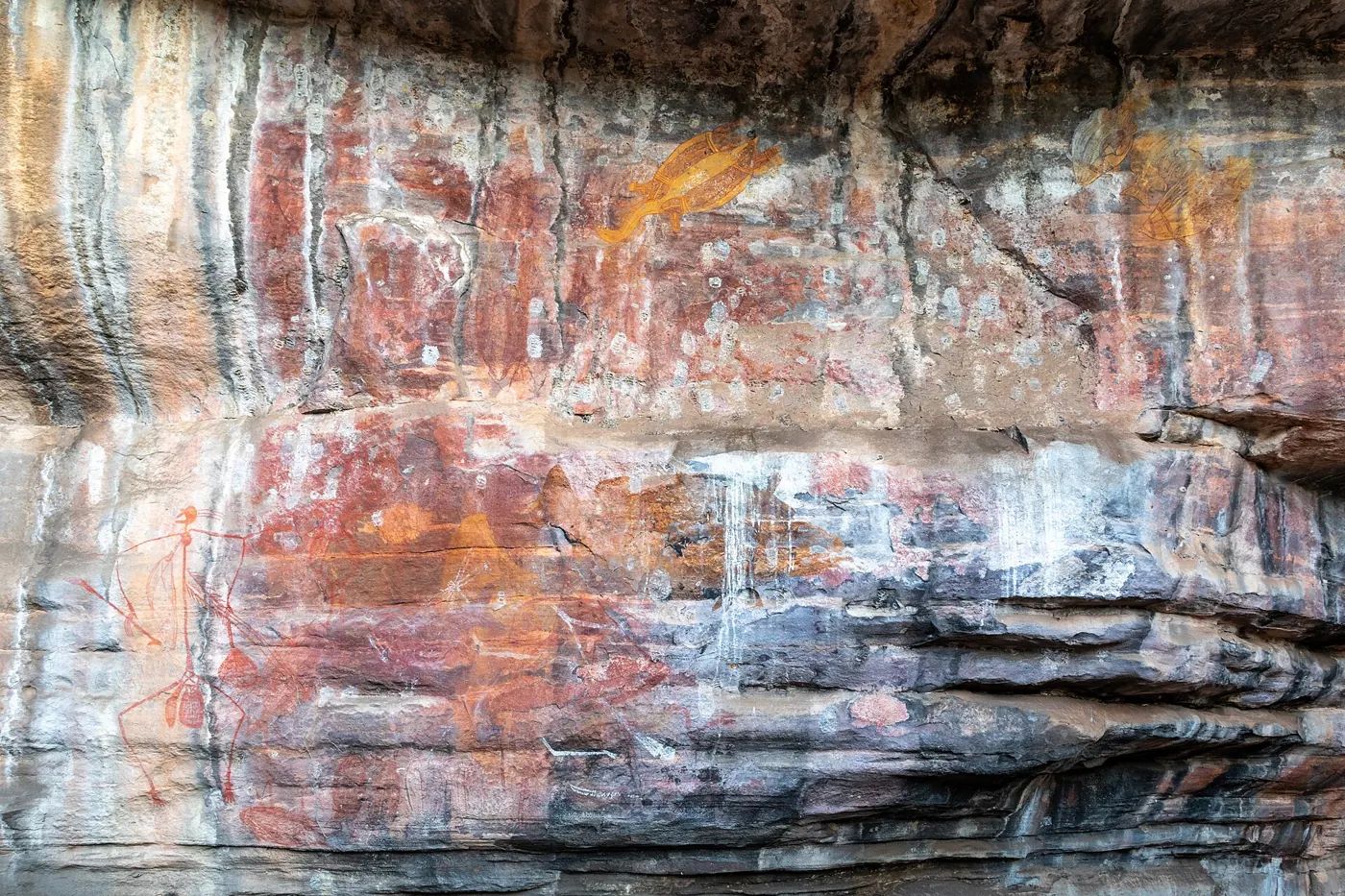
Rock art, wetlands and its dual World Heritage status. UNESCO lists Kakadu for both outstanding natural and cultural values, first added to the list in 1981. Parks Australia says it holds one of the greatest concentrations of rock art in the world, and sites such as Ubirr and Burrungkuy (Nourlangie) are part of why it is listed. The park is also Aboriginal country, cared for and owned by its Bininj/Mungguy Traditional Owners.
Where is the rock art in Kakadu?
Ubirr and Burrungkuy (Nourlangie) are the two main sites most visitors see. Both are reachable by 2WD and both are on the day tours, with Nourlangie used as the backup if Ubirr is closed. On Ubirr, the walk up to the Nadab lookout at sunset is the classic view over the floodplain.
What is the Yellow Water cruise?
A boat cruise on the Ngurrungurrudjba (Yellow Water) wetlands, based at Cooinda. Parks Australia says cruises run all year and you can see saltwater crocodiles, magpie geese, eagles and other birdlife. It recommends sunrise or sunset because crocodiles spend more time submerged in the midday heat. A Yellow Water cruise is in the wet-season swap on the Kakadu Day Tour with Cultural Cruise.
Are there crocodiles in Kakadu?
Yes, and you should assume every body of water has them. Parks Australia says saltwater crocodiles live in billabongs, rivers and creeks across the park, can attack in knee-deep water and stay hidden underwater for long periods. The safe way to see them is from a cruise or a viewing platform. Cahills Crossing is a well-known place to spot them, and the jumping crocodile cruise is on the Adelaide River.
Questions: swimming
Can you swim in Kakadu?
Not safely in natural waterways unless the site is signed and managed. Parks Australia says it can be dangerous to swim in Kakadu’s waterways and natural pools because of crocodiles, flash flooding and strong currents, and that the safest place to swim is a public or hotel pool. Some sites have been fenced and closed to swimming, so never swim at an unsigned spot. Never swim alone. Ask your guide on a tour, and follow the signs.
Can you swim at Kakadu waterfalls?
Only at sites that are open and signed as swimming areas, and that changes through the season. The falls typically do not open until late June, and access varies by water level and crocodile management. The 3 to 5 day tours visit one or more of Gunlom, Maguk, Motor Car Falls, Moline Rockhole and Jim Jim depending on conditions, and the guide picks the safest option on the day.
Questions: Kakadu vs other places
Kakadu vs Litchfield: which is better?
Litchfield is the easy swimming day, Kakadu is the bigger, wilder trip. Litchfield is about 120 km south-west of Darwin and roughly an hour to 90 minutes away, with Wangi Falls, Florence Falls and Buley Rockhole in a short loop. Kakadu is about three hours away and gives you rock art, wetlands and crocodile cruises. The Litchfield Waterfalls and Jumping Crocodile Cruise gibt’s ab 139 € and is the easiest first day out of Darwin.
Can you do Kakadu, Katherine Gorge and Litchfield together?
Yes, on a 4 or 5 day tour from Darwin. The 4-day Kakadu, Katherine Gorge and Litchfield Camping Tour uses powered tents and runs at a relaxed pace for 5 to 16 people. The 5-day 4WD Swag Adventure adds more waterfall time and four nights camping. Both include a two-hour Katherine Gorge (Nitmiluk) cruise.
Is Kakadu worth it?
Yes, if you like wildlife, rock art and big landscapes, and you are happy to put a few days into it. It is a long way from anywhere, and a day trip only touches it. If you are unsure, start with the 3-day Kakadu and Litchfield trip, which is the shortest option that includes waterfalls.
Jetzt buchen
Compare every Top End tour, cheapest first, on Darwin tour prices, or browse the Darwin and Top End hub. The shortest option is a day tour with the park pass included. For waterfalls, camping and Litchfield, the 3-day swag adventure is the place to start.
Schlagwörter


